Does Cultivar Gene Escape Impact Local Dogwood Populations?
Study of early fitness consequences for cultivar gene escape into native populations of flowering dogwood.

Jane Remfert, Andrew Eckert, Rodney Dyer
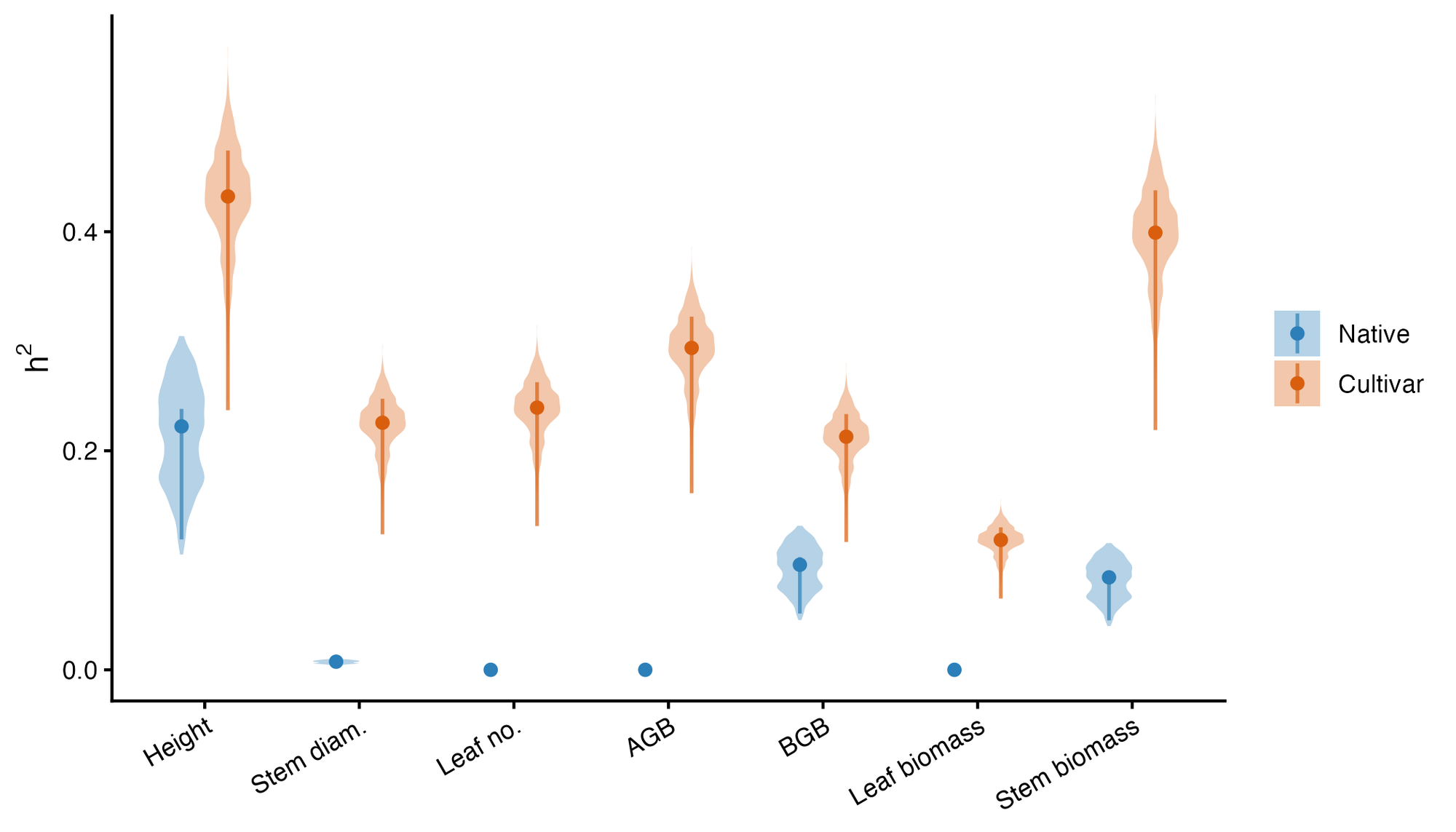
Ornamental cultivars of native plants are increasingly abundant in urban landscapes, creating large domestic reservoirs adjacent to wild populations. Whether cultivar alleles that escape into wild stands persist depends on how cultivar-origin offspring perform during early recruitment into natural habitats. We tested two competing hypotheses for flowering dogwood (Cornus florida): that cultivar ancestry imposes an early fitness penalty under wild conditions (maladaptation), or that cultivar-origin seedlings perform at least as well as wild seedlings, leaving early viability selection unable to restrain gene escape (cultivar persistence). We monitored survival, growth, and biomass over two growing seasons for 569 open-pollinated seedlings from 36 maternal families (20 managed landscape, 16 second-growth forest) grown in an unmanipulated, deeply shaded forest understory common garden. We classified seedlings by landscape provenance (maternal origin) and neutral genetic ancestry (admixture percentage with commercial voucher lines). Overall survival was high (~ 82%) and did not differ by origin or admixture score. While origin explained little growth variation, maternal family accounted for substantial variation among cultivar-origin seedlings, yielding moderate narrow-sense heritabilities for height, above-ground biomass, and stem biomass (h2 0.3-0.5) alongside heterogeneous family survival. Native families, in contrast, exhibited no heritable variation across any measured trait. Cultivar-origin seedlings were not disadvantaged in a deeply shaded understory, suggesting that early viability selection is unlikely to limit the establishment of escaped cultivar alleles. These results highlight the potential for long-term introgression and genetic homogenization in declining wild C. florida populations.