BloomSpread: A Course Design Framework for Quantifying Cognitive Scaffolding
Bloom Spread is a novel metric that quantifies cognitive complexity in educational design by aggregating Bloom’s taxonomy classifications from individual assessments through learning objectives to course and program outcomes.


Bloom Spread is a novel metric that quantifies cognitive complexity in educational design by aggregating Bloom’s taxonomy classifications from individual assessments through learning objectives to course and program outcomes. Unlike traditional assessment tools that show only static distribution of cognitive levels, Bloom Spread enables temporal analysis of how cognitive demand evolves across time, revealing multiple overlapping developmental arcs rather than simple linear progression.
TL;DR
BloomSpread is a metric that quantifies cognitive complexity in educational design by aggregating Bloom's taxonomy classifications from individual assessments through learning objectives to course and program outcomes. Unlike traditional assessment tools that show only static distribution of cognitive levels, Bloom Spread enables temporal analysis of how cognitive demand evolves across time, revealing multiple overlapping developmental arcs rather than simple linear progression.
This framework addresses a critical gap in educational assessment: the ability to visualize and quantify whether courses actually scaffold learning or simply pile on content. By tracking cognitive complexity temporally and enforcing structural alignment through backwards design, Bloom Spread provides data-driven insights for course improvement, program review, and accreditation documentation.
The Problem
What Traditional Assessment Tools Miss
Traditional assessment analysis focuses on static distribution: 'This course has 30% Apply, 40% Analyze, 30% Create.' While useful, this tells us nothing about:
- Whether complexity builds appropriately across the semester
- If scaffolding supports student development
- When critical transitions occur in cognitive demand
- Whether different learning outcomes follow independent developmental arcs
The Temporal Blindness Problem
Without temporal analysis, we cannot distinguish between:
- Well-scaffolded progression: Foundational skills → Application → Integration → Creation
- Front-loaded complexity: Demanding synthesis before mastery of basics
- Flat progression: No development—same cognitive level throughout
- The 'cliff': Sudden jump to high complexity without intermediate steps
Each pattern produces the same static distribution but vastly different student experiences and outcomes.
The Bloom Spread Framework
Foundational Elements
Bloom's Revised Taxonomy
The framework uses Bloom's Revised Taxonomy as its cognitive complexity scale:
- Remembering: Recalling or recognizing information
- Understanding: Explaining ideas or concepts
- Applying: Using information in familiar situations
- Analyzing: Breaking information into parts to explore relationships
- Evaluating: Justifying a decision or course of action
- Creating: Generating new ideas, products, or ways of viewing things
Hierarchical Aggregation Structure
Bloom Spread aggregates upward through the assessment hierarchy:
- Individual Assessment: Tagged with one or more Bloom levels based on required cognitive operations
- Module Learning Objective (MLO): Inherits complexity from all mapped assessments
- Course Learning Outcome (CLO): Inherits complexity from all mapped objectives
- Program Learning Outcome (PLO): Inherits complexity from all mapped courses
Each level displays: (1) numerical average (e.g., 3.4, 4.5, 6.0), (2) distribution pie chart showing proportions of each Bloom level, and (3) temporal progression showing how complexity evolves over time.
Structural Enforcement: Backwards Design
The framework enforces backwards design through data structure requirements:
- Cannot create a Module without defining at least one Course Learning Outcome
- Cannot create an Assessment without defining at least one Module Learning Objective
- Every Assessment must map to at least one MLO and one CLO
- Every Assessment must be tagged with one or more Bloom taxonomy levels
This prevents assessments from being created in isolation and ensures constructive alignment (Biggs, 1996) — every assessment must explicitly connect to the pedagogical outcomes it serves.
Temporal Analysis: The Key Innovation
Beyond Static Metrics
The temporal dimension is Bloom Spread's primary innovation. Rather than reducing a course to a single static metric, the framework reveals the dynamic process of skill development across time.
What Temporal Analysis Shows
Traditional (Static) View:
'This course has 30% Apply, 40% Analyze, 30% Create' — useful but doesn't show development.
Temporal Bloom Spread View:
- Early assessments focus on foundational skills (Bloom ~2.5)
- Mid-semester complexity increases as tools are mastered (Bloom ~4.0)
- Late semester demands synthesis and creation (Bloom ~5.5)
- Shows whether scaffolding is appropriate for student development
Overlapping Developmental Arcs
Real learning doesn't follow a single linear progression. Bloom Spread tracks multiple overlapping developmental arcs for different course learning outcomes, each following an introduce → reinforce → assess for mastery pattern.
Three-Phase Developmental Arc:
- Introduction Phase (rising curve): New concept/skill introduced, low-stakes practice, formative assessment, Bloom Spread increases
- Reinforcement Phase (plateau): Sustained practice, skill applied in various contexts, multiple assessments at mastery level, Bloom Spread maintains
- Integration Phase (maintenance or slight decline): Skill becomes prerequisite for higher work, integrated into complex assessments, may show lower direct measurement as embedded in other outcomes
Grade-Weighted Calculation
Critical methodological requirement: Bloom Spread must be grade-weighted to accurately represent pedagogical intent. Without weighting, low-stakes assessments (quizzes, formative activities) dominate temporal graphs despite high-stakes integration assessments (papers, projects, exams) being the actual drivers of cognitive progression.
Example:
- 10 weekly quizzes (Bloom 2) at 1% each = 10% of grade
- 5 activities (Bloom 3-4) at 4% each = 20% of grade
- 4 integration papers (Bloom 5-6) at 17.5% each = 70% of grade
Unweighted: Low Bloom scores would dominate (15 lower-level assessments vs. 4 higher-level).
Grade-weighted: Papers appropriately drive the temporal trajectory while activities provide developmental scaffolding.
Taxonomy of Temporal Bloom Patterns
Empirical observation reveals four primary temporal patterns, each appropriate for different course types and levels.
Type 1: Sequential Mastery
Pattern: Each outcome rises independently with minimal temporal overlap. Each plateaus before the next begins. Bloom Spread increases in discrete steps.
Appropriate for: Foundational courses, skills-based courses with clear prerequisites, students new to the domain, building fundamental competencies.
Example: Programming 101 (syntax → algorithms → projects)
Type 2: Spiral Integration
Pattern: Significant overlap between arcs. Earlier outcomes decline as later ones rise. Skills integrate into higher-level work. Continuous reinforcement through integration.
Appropriate for: Middle-level courses, building on established foundations, connecting multiple skill domains, progressive skill development.
Example: Data literacy (tools → analysis → communication)
Type 3: Sustained Parallel Complexity
Pattern: All outcomes plateau at high Bloom levels simultaneously. Simultaneous high-order thinking. Minimal sequential dependency. Sustained cognitive demand.
Appropriate for: Graduate seminars, capstone courses, research-intensive courses, domain experts deepening expertise.
Example: Graduate research design (literature review + methods + analysis all at Evaluate/Create level)
Type 4: Convergent Integration
Pattern: Multiple arcs converge at end. All outcomes assessed simultaneously in final project. Peak complexity at semester end. Heavy integration requirement.
Appropriate for: Senior capstone courses, final projects/theses, portfolio courses, demonstration of cumulative learning.
Example: Senior thesis (research + analysis + writing + presentation all converge)
Anti-Patterns: What NOT to Do
Five common temporal patterns that research and learning theory suggest are pedagogically problematic:
The Spike-and-Abandon
Problem: Topics covered but not reinforced. Student experience: 'We learned this but never used it again.' Outcome: Poor retention, fragmented understanding.
Fix: Add reinforcement assessments, integrate earlier skills into later work.
The Flat Line
Problem: No progression—all assessments at same complexity. Student experience: 'This course was just busy work.' Outcome: No skill development, same cognitive level start to finish.
Fix: Redesign assessments to show progression from foundational to advanced.
The Cliff
Problem: Sudden jump to high complexity without scaffolding. Student experience: 'Final project came out of nowhere.' Outcome: High stress, poor performance, complaints about fairness.
Fix: Add intermediate-complexity assessments to bridge the gap.
The Inverted Progression
Problem: Starts complex, becomes simpler. Student experience: 'First exam was hardest, got easier from there.' Outcome: Misaligned with learning theory, wastes early confusion.
Fix: Resequence assessments to build from foundation to complexity.
Premature Integration
Problem: Expecting integration before foundations are established. Student experience: 'I have to do X but we haven't learned Y yet.' Outcome: Frustration, poor work quality, learned helplessness.
Fix: Delay integration requirements until prerequisite skills are established.
Pedagogical Insights
Key Questions Bloom Spread Answers
For Course Design
- Are you actually scaffolding learning, or just piling on content?
- Does your course cognitive demand match the level you're teaching at?
- Are you assessing what you think you're assessing?
- When should I introduce new content? (Look at prerequisite outcome curves)
- Am I reinforcing foundational skills enough? (Check if curves maintain or drop)
- Why are students struggling with the final project? (Check if integration curve starts too late)
For Program Directors
- Does your curriculum show progression from intro to capstone?
- Are graduate courses actually more cognitively demanding than undergrad?
- Where are the gaps in your program's cognitive development?
- Does our intro course establish foundations that advanced courses build on?
- Are we spiraling concepts appropriately across the curriculum?
For Accreditation
- Quantitative evidence of scaffolding across courses and programs
- Visual demonstration of progressive complexity from freshman to senior year
- Data-driven curriculum improvement documentation
- Clear chain of evidence from assignments to program outcomes
Cross-Course Expectations
Introductory Courses
Expected pattern: Average Bloom Spread 2.0-3.5 across semester. Focus on Remember → Understand → Apply.
Intermediate Courses
Expected pattern: Average Bloom Spread 3.0-4.5 across semester. Focus on Apply → Analyze.
Advanced/Graduate Courses
Expected pattern: Average Bloom Spread 4.0-6.0 across semester. Focus on Analyze → Evaluate → Create.
Warning Signs
- Intro course with average Bloom Spread > 4.5 (too demanding for foundational level)
- Graduate course with average Bloom Spread < 3.5 (not sufficiently advanced)
- Any course with flat Bloom Spread (no progression)
- Any course with inverted Bloom Spread (backwards progression)
Theoretical Foundations
Bloom Spread operationalizes established learning theories:
Bloom's Taxonomy Anderson and Krathwohl (2001)
Hierarchical model of cognitive complexity providing the measurement framework. Foundation: Remember, Understand. Application: Apply. Higher-order: Analyze, Evaluate, Create.
Spiral Curriculum (Bruner 1961)
Revisit concepts at increasing complexity, build on prior knowledge, progressive deepening of understanding. Maps to overlapping Bloom Spread arcs showing how earlier skills integrate into later work.
Scaffolding (Vygotskii 1978)
Zone of Proximal Development, temporary support for skill development, gradual release of responsibility. Visualized in Bloom Spread temporal progression from guided practice to independent mastery.
Constructive Alignment (Biggs 1996)
Learning outcomes, teaching methods, and assessments must align. Bloom Spread enforces structural alignment through required mappings. Assessment → Objective → Outcome chain ensures coherence.
Cognitive Load Theory (Sweller 1988)
Manage intrinsic, extraneous, and germane load. Anti-patterns (cliffs, premature integration) indicate excessive cognitive load. Appropriate Bloom Spread progression manages cognitive load across time.
Research Applications
Potential Research Questions
Descriptive Research
- What temporal Bloom patterns are most common in intro biology courses?
- Do patterns differ by discipline (STEM vs humanities vs social sciences)?
- How do patterns change from intro → intermediate → advanced?
- What is the typical Bloom Spread range for each course level?
Correlational Research
- Does Sequential Mastery pattern correlate with higher student success in foundational courses?
- Do anti-patterns correlate with student complaints or DFW rates?
- Does Spiral Integration correlate with better retention one year later?
- Is there a relationship between Bloom Spread progression and course evaluations?
Experimental Research
- If we redesign Course X from Spike-and-Abandon to Spiral Integration, do outcomes improve?
- Does showing instructors their temporal pattern lead to course improvements?
- Can we train faculty to recognize and avoid anti-patterns?
- Does optimizing Bloom Spread progression reduce DFW rates?
Program-Level Research
- Does our curriculum show appropriate progression across the degree program?
- Where are the gaps between courses that need curricular scaffolding?
- How does Bloom Spread align with program learning outcomes?
- What is the cumulative Bloom Spread across a complete degree program?
Implementation: BackflowStudio
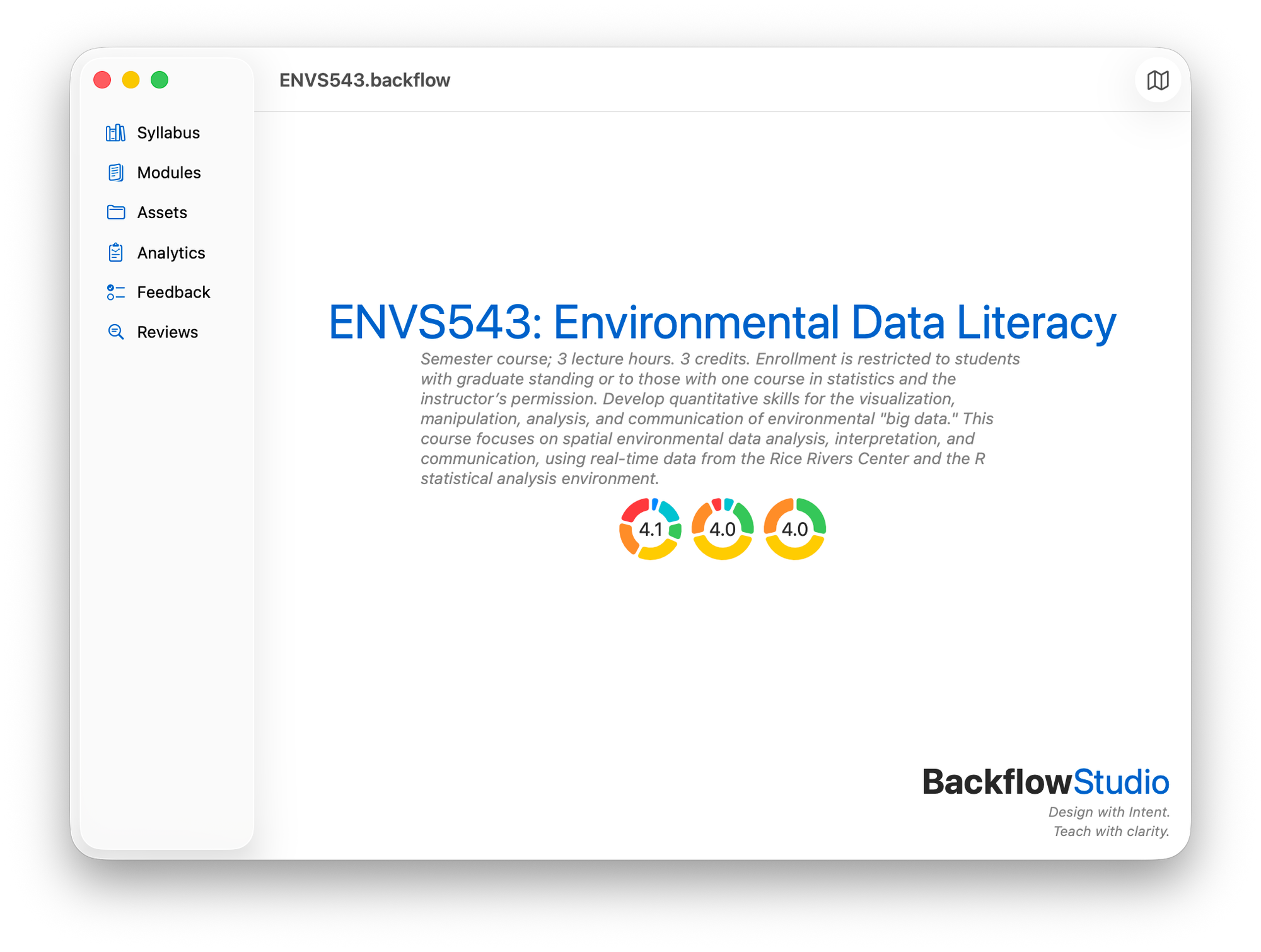
BackflowStudio is a macOS/iOS application that operationalizes the Bloom Spread framework for course design and analysis. The application enforces backwards design principles through data structure while providing visualization and reporting tools for temporal Bloom analysis. A complete discussion of this application is found at https://backflow.studio.
BackflowStudio is a semantic layer above your teaching materials that makes pedagogical connections visible, measurable, and improvable over time.
Core Features
1. Visual Curriculum Mapping
- Interactive graph visualization connecting outcomes → objectives → assessments → assets
- Clear visual representation of how learning flows through the course
- Shows alignment and gaps at a glance
2. Backward Design Framework
- Structured approach: define outcomes first, then objectives, then assessments
- Flat data architecture that maintains explicit relationships between all elements
- Module-based organization with clear hierarchies
3. Bloom's Taxonomy Integration
- Every assessment tagged with cognitive complexity levels (Remember → Create)
- Color-coded visualization of complexity distribution
- Temporal Bloom Trajectory - track cognitive complexity across the semester
- "BloomSpread" analytics to ensure balanced cognitive demands
4. On-Device AI Assistance
- Assessment Reasoning Agent - evaluates pedagogical coherence and alignment with objectives
- AI-Assisted Authoring - helps refine outcomes, objectives, and assessment descriptions
- Feedback Summarization - generates AI summaries of student evaluations
- All AI runs locally using Apple's FoundationModels (no cloud dependency)
5. Longitudinal Analytics & Review
- Track enrollment trends across multiple terms
- Analyze student feedback patterns (quantitative + qualitative sentiment analysis)
- Generate annual review materials from aggregated data
- Reflective teaching notes (categorized as feedback, tasks, reviews)
6. Medium-Agnostic Deployment
- Link to materials on any platform (Google Drive, Canvas, Dropbox, etc.)
- Export to HTML/PDF for sharing or LMS integration
- Doesn't force you into a specific ecosystem
Three-Column Mapping View
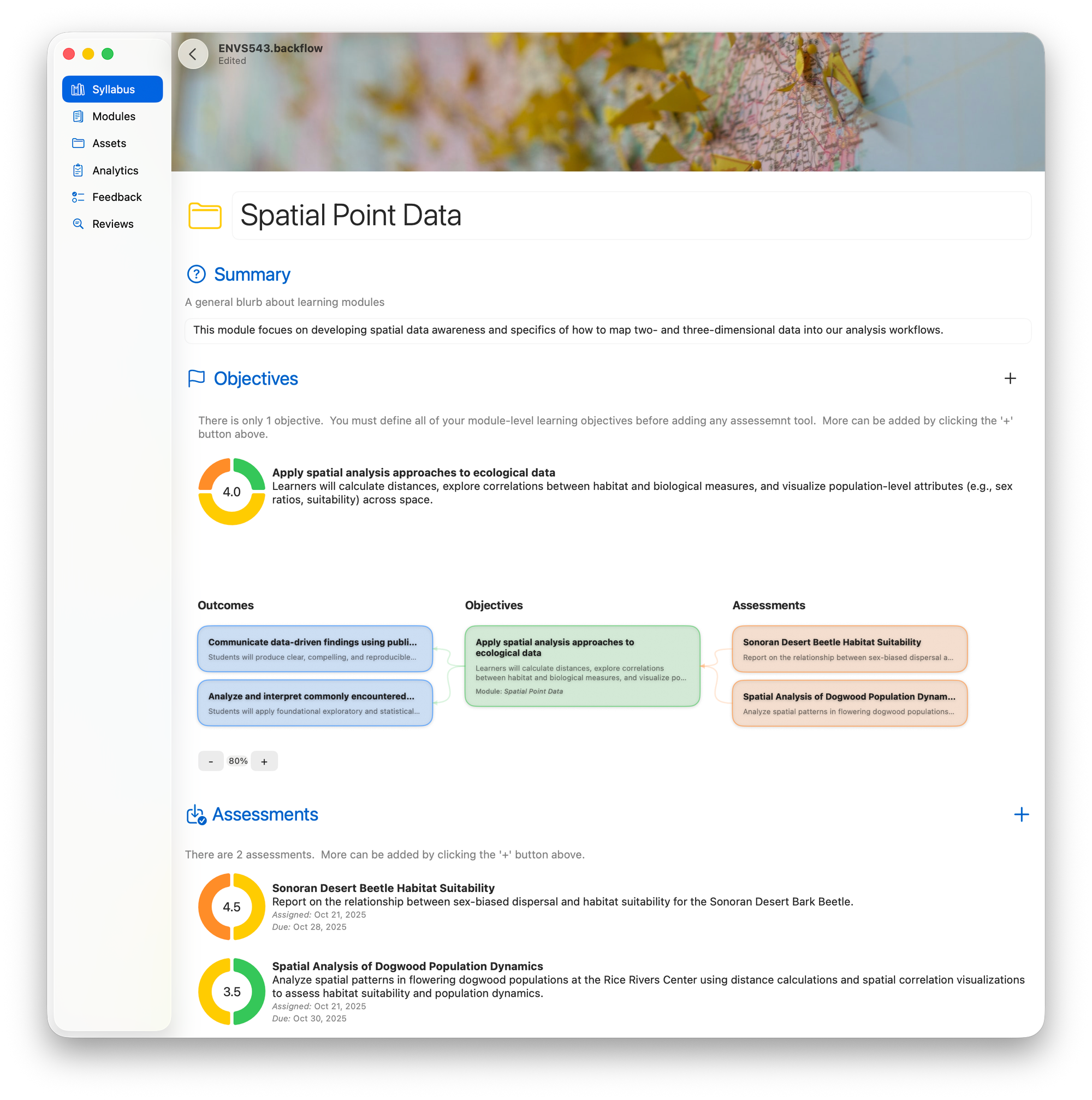
Visual interface showing Course Learning Outcomes (blue cards), Module Learning Objectives (green cards), and Assessments (orange/varied cards) with connection lines displaying mappings. Bloom Spread for assessment and accumulated onto each objective.
Temporal Visualizations
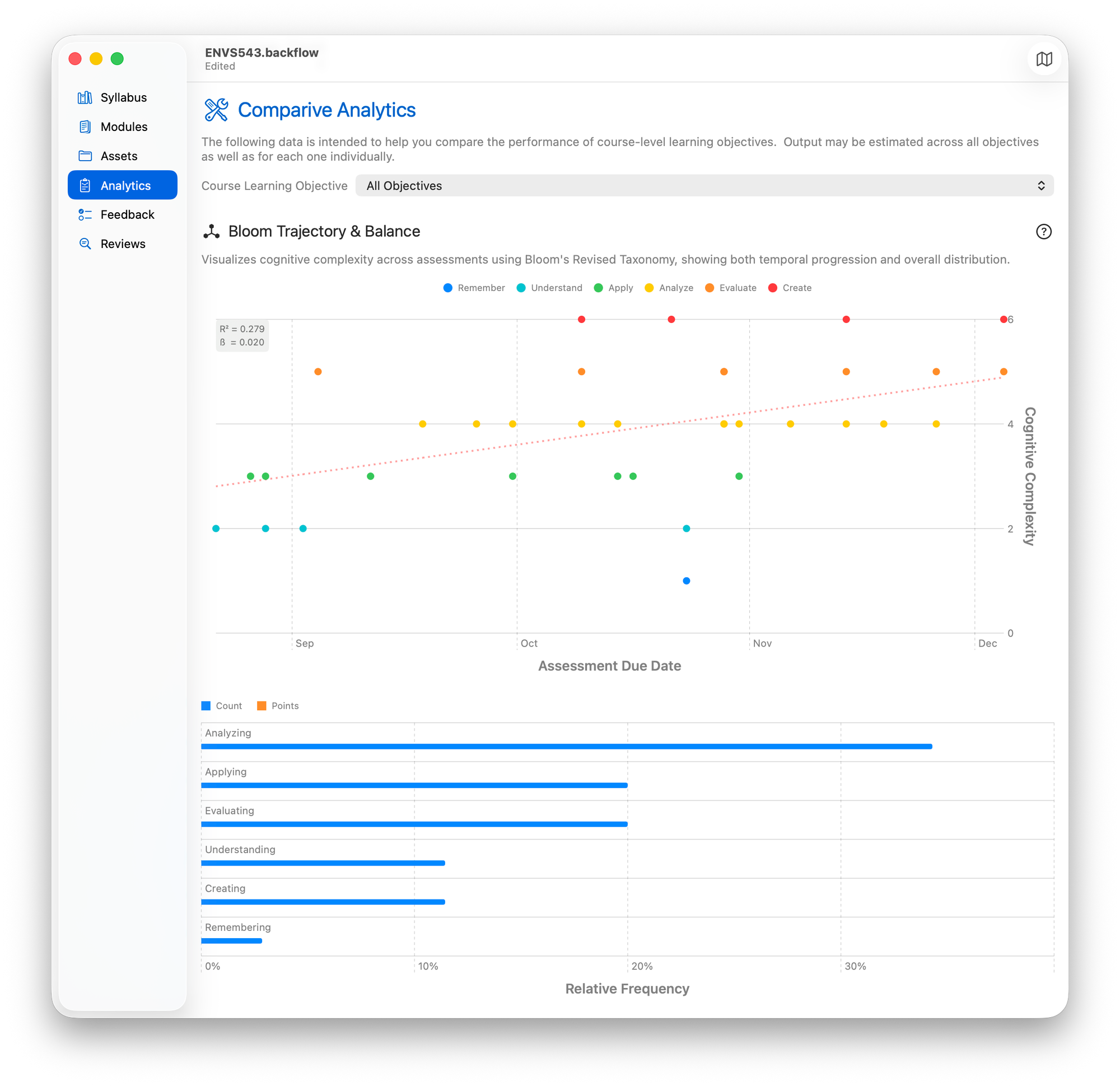
- Temporal line graphs: X-axis = time (weeks, modules, assessment due dates), Y-axis = Bloom Spread (1.0-6.0), multiple lines for different CLOs showing overlapping developmental arcs
Analytics
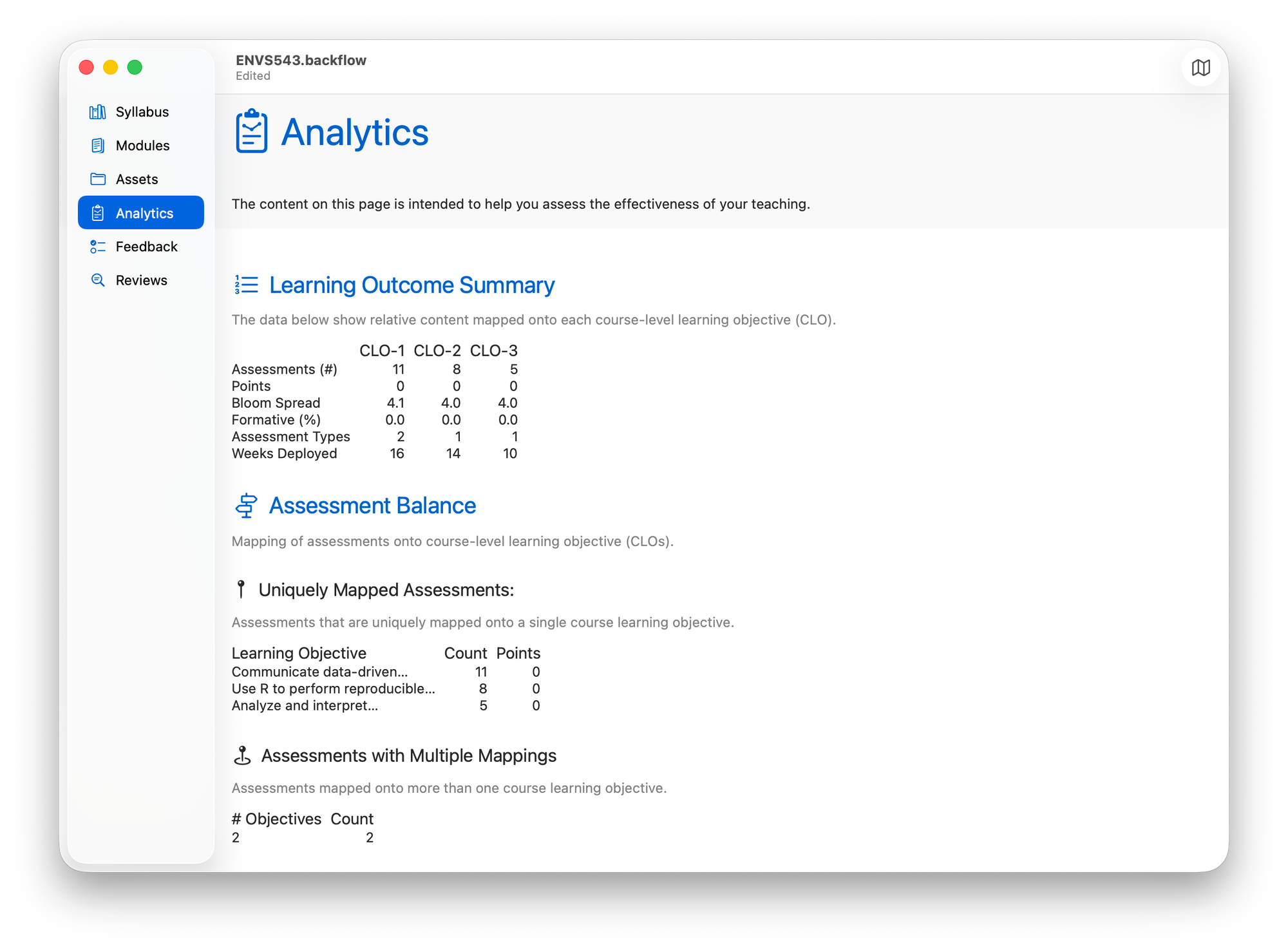
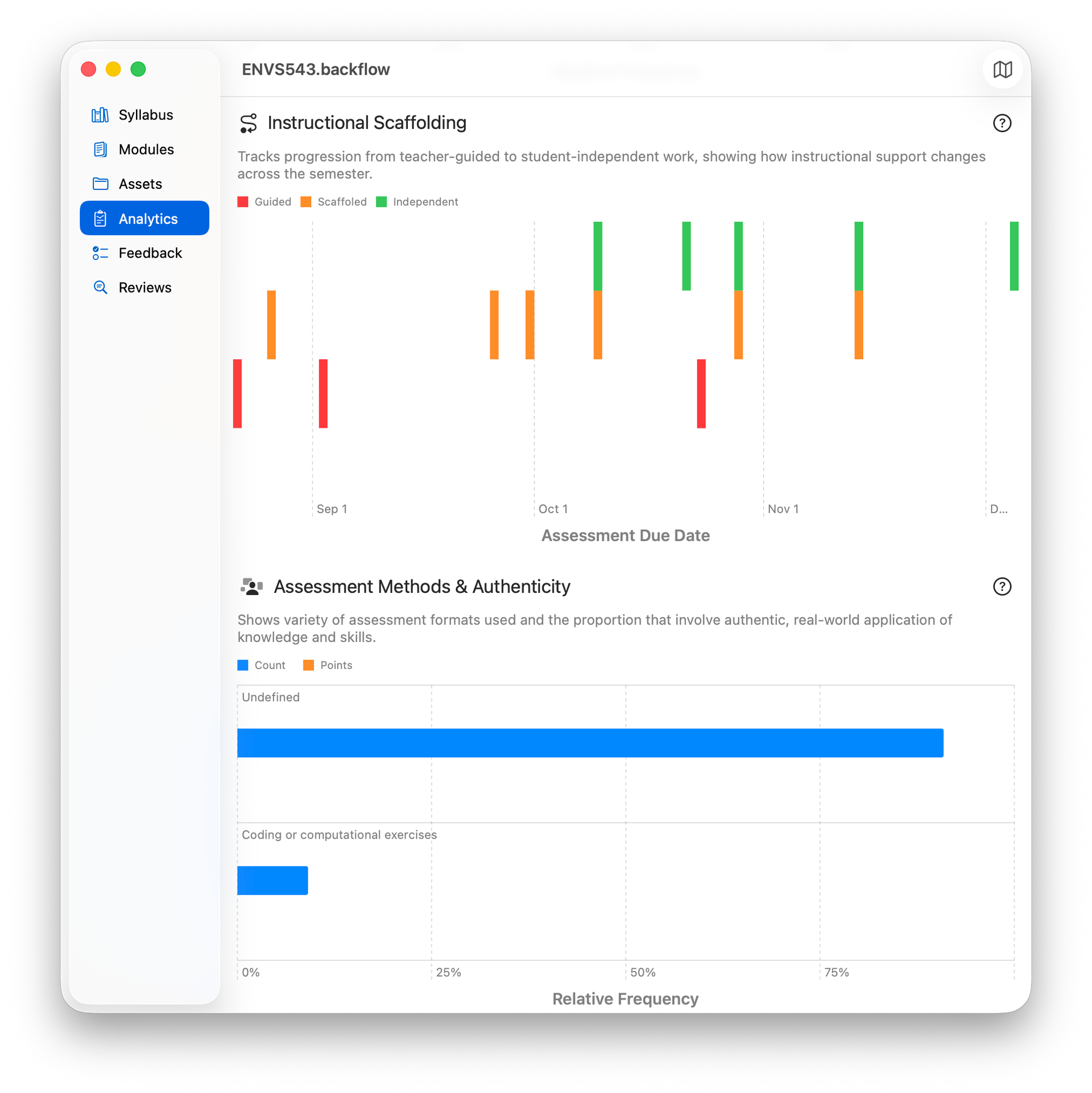
- "Your Pattern" Analysis: Shows course's temporal Bloom graph, identifies which pattern type it matches, assesses appropriateness for course level
- "Cognitive Progression" View: Temporal graph for each CLO, overall course Bloom Spread progression, identifies key transition points
- "Bloom Balance" Dashboard: Pie charts showing distribution, comparison to norms for course level, identifies over/under-represented levels
- "Anti-Pattern Detection": Flags potential issues (cliffs, premature integration), explains why problematic, suggests specific scaffolding improvements
- "Export for Publication": Clean graphs for papers/presentations, anonymized data for research, publication-ready visualizations
Target Users
- University professors: Course design, assessment planning, temporal analysis of cognitive scaffolding
- K-12 teachers: Unit planning, standards alignment, progressive skill development
- Instructional designers: Course quality assurance, backwards design enforcement, data-driven improvement
- Department chairs: Program review, curriculum coherence analysis, faculty development support
Conclusion
Bloom Spread represents a significant innovation in educational assessment and course design. By quantifying cognitive complexity and enabling temporal analysis of how that complexity develops, it:
- Makes the invisible visible: Shows pedagogical structure that typically exists only in instructor minds
- Enables data-driven improvement: Identifies anti-patterns and validates effective scaffolding
- Supports multiple levels: From individual assessments to program-wide outcomes
- Connects theory to practice: Operationalizes learning theory concepts (scaffolding, spiral curriculum, constructive alignment)
- Facilitates research: Provides quantitative data for studying curriculum effectiveness
The temporal analysis capability—showing multiple overlapping developmental arcs—represents a particularly novel contribution. Rather than reducing a course to a single static metric, Bloom Spread reveals the complex, dynamic process of skill development across time.
As faculty use this framework to analyze and improve their courses, and as researchers study the patterns that emerge, Bloom Spread has the potential to establish new evidence-based best practices for curriculum design and provide a common language for discussing cognitive scaffolding in higher education.
References
- Anderson, Lorin W, and David R Krathwohl. 2001. A Taxonomy for Learning, Teaching and Assessing: A Revision of Bloom’s Taxonomy of Educational Objectives: Complete Edition. Longman.
- Biggs, John. 1996. “Enhancing Teaching Through Constructive Alignment.” Vol. 32. Kluwer Academic Publishers.
- Bruner, Jerome S. 1961. The Process of Education. Harvard University Press.
- Benjamin S. and Krathwohl, DR, and Bloom BM. 1956. Taxonomy of Educational Objectives : The Classification of Educational Goals. First Edition. David McKay Company.
- Sweller, John. 1988. “Cognitive Load During Problem Solving: Effects on Learning.” Cognitive Science 12 (April): 257–85. https://doi.org/10.1207/s15516709cog1202_4.
- Vygotskii, L. S. 1978. Mind in Society: The Development of Higher Psychological Processes. Harvard University Press.